Scientists Detect Gamma Rays That May Reveal Dark Matter
Is this humanity finally detecting elusive dark matter, or are scientists chasing another cosmic mirage?
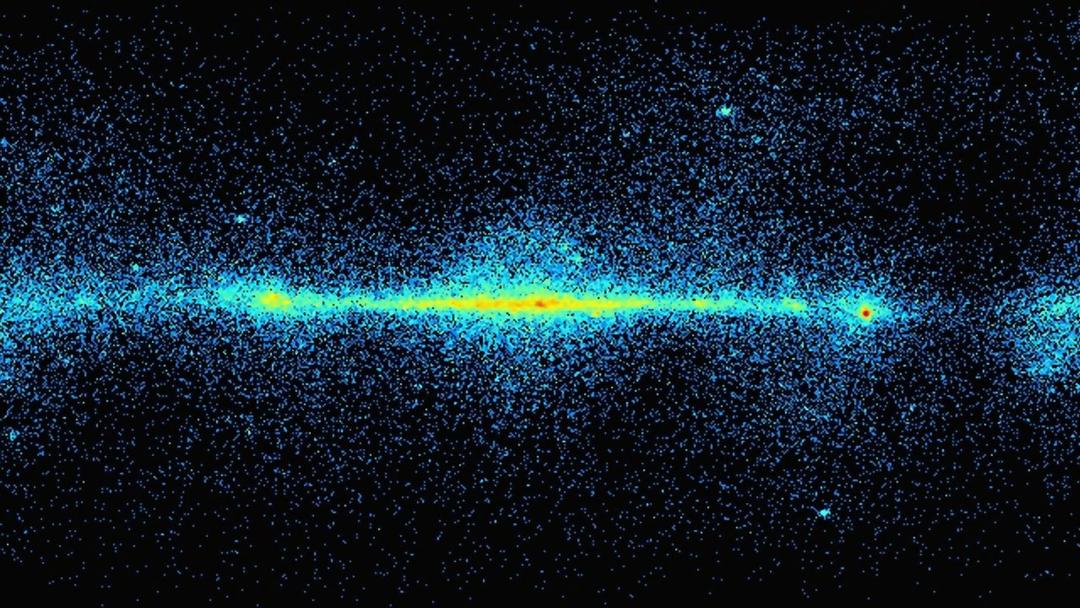
Above: Image taken from a NASA Internet site of the Compton Gamma-Ray Observatory spacecraft's Energetic Gamma-Ray Experiment Telescope (EGRET) data on March 21, 2000. Image credit: NASA/AFP/Getty Images
The Facts
- University of Tokyo Professor Tomonori Totani analyzed 15 years of data from NASA's Fermi Gamma-ray Space Telescope and detected gamma rays with 20 gigaelectronvolts energy extending in a halo structure toward the Milky Way's center — potentially the first direct evidence of the existence of dark matter.
- The observed gamma-ray emissions match theoretical predictions for weakly interacting massive particles (WIMP) annihilation, suggesting that dark matter particles are approximately 500 times more massive than protons.
- Dark matter is theorized to comprise 27% of the universe, while ordinary matter, like stars and planets, accounts for only about 5% of the universe's total composition — the rest is made up of something called dark energy.


Sources Split
LEFT
CENTER
RIGHT
+1
+3
+1
ESTAB
CRIT
CENTER
PRO
ESTAB
The Spin
Narrative A
Dark matter is nothing more than a scientific mirage that physicists have been chasing for decades. New theories show that wobbly spacetime fluctuations can explain galactic rotation and cosmic expansion without needing invisible matter that's never been directly observed.


Narrative B
Scientists have finally captured the first direct evidence of dark matter using NASA's Fermi telescope, detecting powerful gamma-ray radiation from colliding dark matter particles. This observation matches theoretical predictions perfectly and marks humanity's first glimpse of the invisible substance.
Metaculus Prediction
© 2026 Improve the News Foundation. All rights reserved.Version 7.17.1
© 2026 Improve the News Foundation.
All rights reserved.
Version 7.17.1