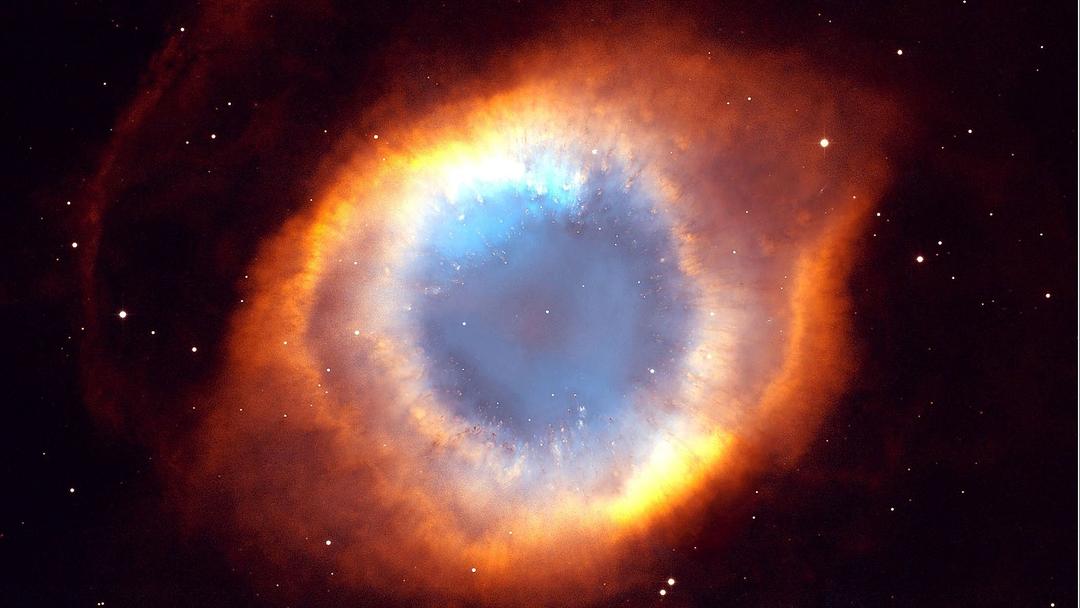
New Image Reveals Dying Star's Debris in Helix Nebula
The Facts
- An international team, including Northwestern University astrophysicists, captured a new image of the Helix Nebula showing fragments of a dying star being stripped and mixed into interstellar space. The study was published on Wednesday in Nature.
- Researchers identified 22 complete or partial "bow shocks" on the eastern side of the nebula, glowing arcs formed as invisible clumps of stellar debris collide with surrounding gas, resembling waves in front of a moving boat.
- Lead author Pieter van Dokkum said, "We are seeing material shed near the end of a star's life being broken apart and returned to the galaxy," adding that the sun will undergo a similar process in the future.


Sources Split
LEFT
CENTER
RIGHT
+4
+1
ESTAB
CRIT
CENTER
PRO
ESTAB
The Spin
Narrative A
This finding reveals a crucial step in cosmic recycling: when stars die, they return elements such as carbon and oxygen to the galaxy, where those ingredients can eventually become part of new stars, planets and ultimately life. Astronomers knew this cycle existed, but the handoff from stellar debris into interstellar space had been difficult to observe directly. The Helix Nebula now shows that process in action.

Narrative B
This new image of the Helix Nebula also shows that stellar recycling is messier than astronomers once thought. Instead of flowing smoothly outward, material from the dying star travels like "shrapnel," colliding with surrounding gas and slowly breaking apart. The 22 bow shocks reveal this destruction unfolding across space, giving astronomers their clearest view yet of how stellar ejecta actually disperses.

Metaculus Prediction
© 2026 Improve the News Foundation.
All rights reserved.
Version 7.17.1