Scientists Find Molten Planet Covered in Magma Ocean
The Facts
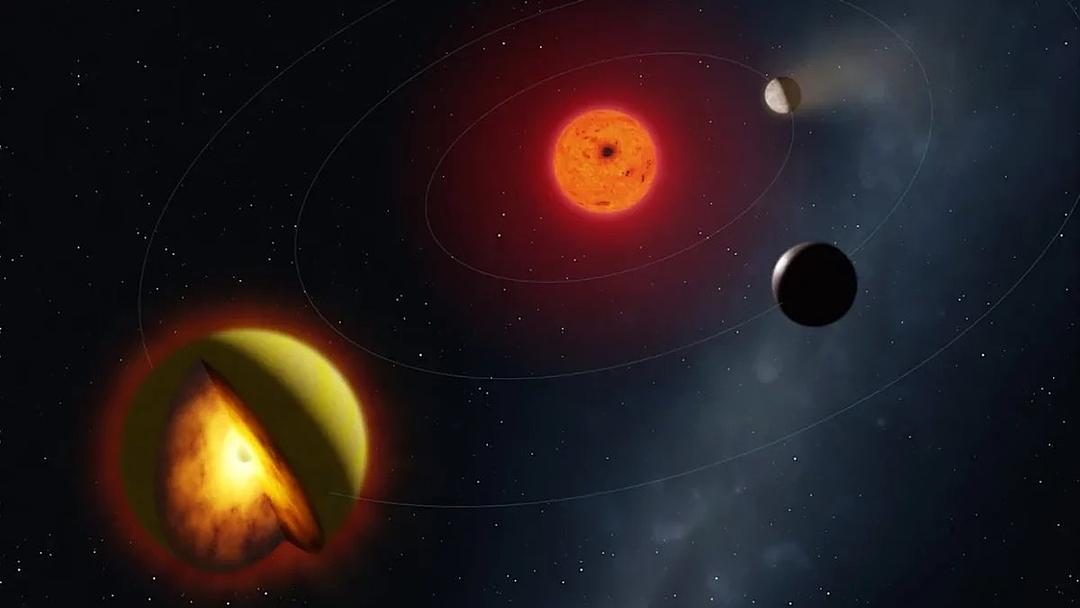
- Astronomers have identified a potential new class of planet, L 98-59 d, which orbits a small red star about 35 light-years from Earth and is approximately 1.6 times the size of Earth. Their findings were published in the journal Nature Astronomy on Monday.
- Data from the James Webb Space Telescope and ground-based observatories revealed that L 98-59 d has an unusually low density and an atmosphere containing significant amounts of hydrogen sulfide, a gas associated with the smell of rotten eggs.
- Researchers from the University of Oxford, the University of Groningen, the University of Leeds and ETH Zurich used computer simulations to reconstruct the planet's history over nearly five billion years, finding that its mantle is likely molten silicate, similar to lava on Earth.


Sources Split
LEFT
CENTER
RIGHT
+2
+1
+1
+4
ESTAB
CRIT
CENTER
PRO
ESTAB
The Spin
Narrative A
L 98-59 d isn't just a weird planet — this molten sulfur world, kept liquid by its own thick atmosphere rather than stellar radiation, breaks every category astronomers rely on. Missions like PLATO and ARIEL are coming, and the galaxy is almost certainly full of these strange worlds just waiting to shatter previous assumptions about how planets work.

Narrative B
While scientists claim the discovery of a "new class" of molten planet, the interpretation relies heavily on simulations and limited telescope data. The extreme sulfur atmosphere and magma ocean inferred for L 98-59 d remain indirect estimates. Without direct observation of its surface or interior, the classification could change as future measurements refine the planet's properties.

Metaculus Prediction
Go Deeper


© 2026 Improve the News Foundation.
All rights reserved.
Version 7.17.1