Webb Telescope Discovers Ancient 'Black Hole Star'
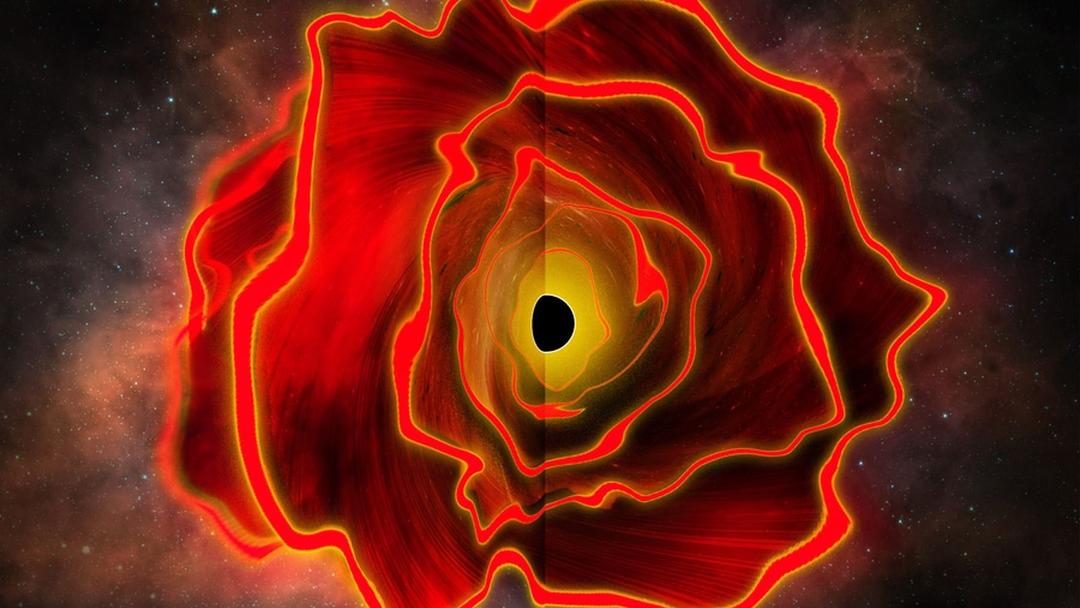
The Facts
- Astronomers led by Rohan Naidu of the University of Hawaii reported in Nature on Wednesday the discovery of MoM-BH*-1, a newly identified type of object dubbed a "black hole star," found 660 million years after the Big Bang.
- The object appears about the size of the solar system and radiates roughly 100 billion times more energy than any known star, a level of luminosity more consistent with a black hole than nuclear fusion.
- Researchers concluded the object features a central black hole of around 100,000 solar masses, surrounded by a dense hydrogen cocoon roughly the size of the solar system.


Sources Split
LEFT
CENTER
RIGHT
+1
+2
ESTAB
CRIT
CENTER
PRO
ESTAB
The Spin
Narrative A
This black hole star find is huge for understanding how supermassive black holes got so massive so fast in the first hundreds of millions of years after the Big Bang. A gas-wrapped baby black hole can grow by consuming the surrounding gas, eventually dispersing its envelope and fading from view. This may be the missing puzzle piece for how black holes reached enormous masses so early in the universe.
Narrative B
Besides just growth models, this discovery could finally crack the little red dot mystery James Webb has uncovered across the early universe. MoM-BH*-1 gives astronomers a physical template for these enigmatic objects: a gas-shrouded black hole whose accretion makes it glow red. If embedded in young galaxies, these black hole stars could explain the dots — and become the engines of baby quasars.

© 2026 Improve the News Foundation.
All rights reserved.
Version 7.17.0