'Fire Amoeba' Sets Record Surviving 145°F Hot Springs
The Facts
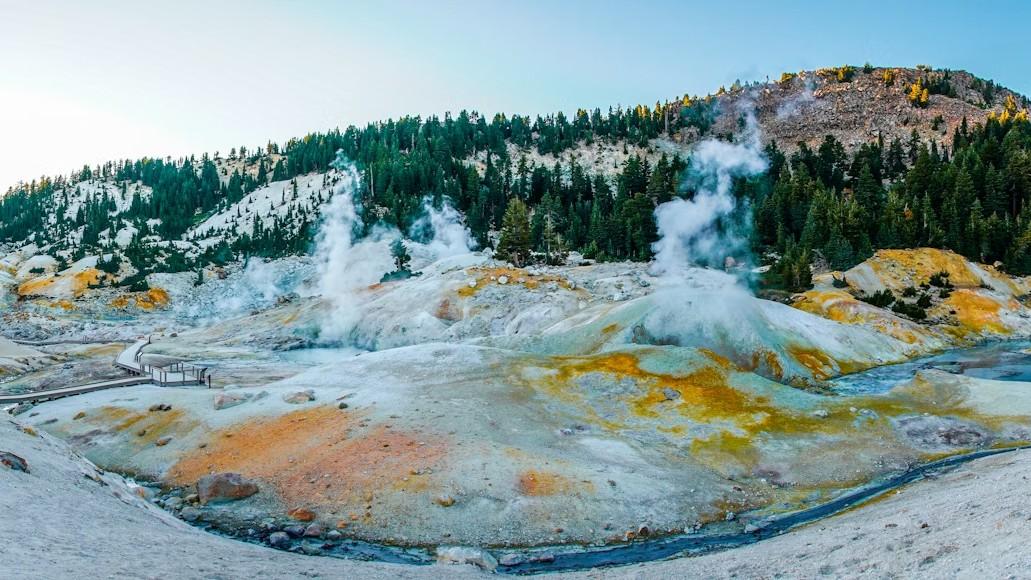
- In a study shared as a preprint on bioRxiv, researchers reported discovering a newly identified single-celled organism, Incendiamoeba cascadensis, meaning "fire amoeba from the Cascades," in hot springs at California's Lassen Volcanic National Park between 2023 and 2025.
- Incendiamoeba cascadensis is classified as an obligate thermophile because it requires temperatures of at least 42°C (107°F) to begin growth. Optimal growth occurs between 55 and 57°C, and it does not grow below 42°C in laboratory conditions.
- According to researchers, the organism can grow and divide at temperatures up to 63°C (145°F), setting a new record for the upper temperature limit across all eukaryotic lifeforms and surpassing the previous record of 57°C held by other amoebae.


Sources Split
LEFT
CENTER
RIGHT
+1
+3

ESTAB
CRIT
CENTER
PRO
ESTAB
The Spin
Narrative A
This discovery completely demolishes previous assumptions about the limits of complex life. This amoeba's ability to remain active at 145°F and revive after exposure to 158°F proves eukaryotic organisms possess far greater adaptability than scientists believed possible. The finding fundamentally reshapes the search for extraterrestrial life by expanding the range of habitable environments, fueling hope for extraterrestrial biology and sustainable tech in extreme climates.

Narrative B
While the fire amoeba sets impressive records, its survival depends on highly specialized adaptations, such as protective cyst formation and heat-shock proteins, that most eukaryotes lack. The "fire amoeba" survived extreme heat in one lab-prepped environment — but its real-world ubiquity, resilience and ecological role remain unclear. Survival in boiling springs doesn't guarantee adaptability elsewhere, nor does it prove life under all extreme planetary conditions.
© 2026 Improve the News Foundation.
All rights reserved.
Version 7.18.2