Icy World Found Far Past Pluto May Be New Dwarf Planet
Is ED138 a landmark dwarf planet discovery or merely a clue to a far larger hidden world?
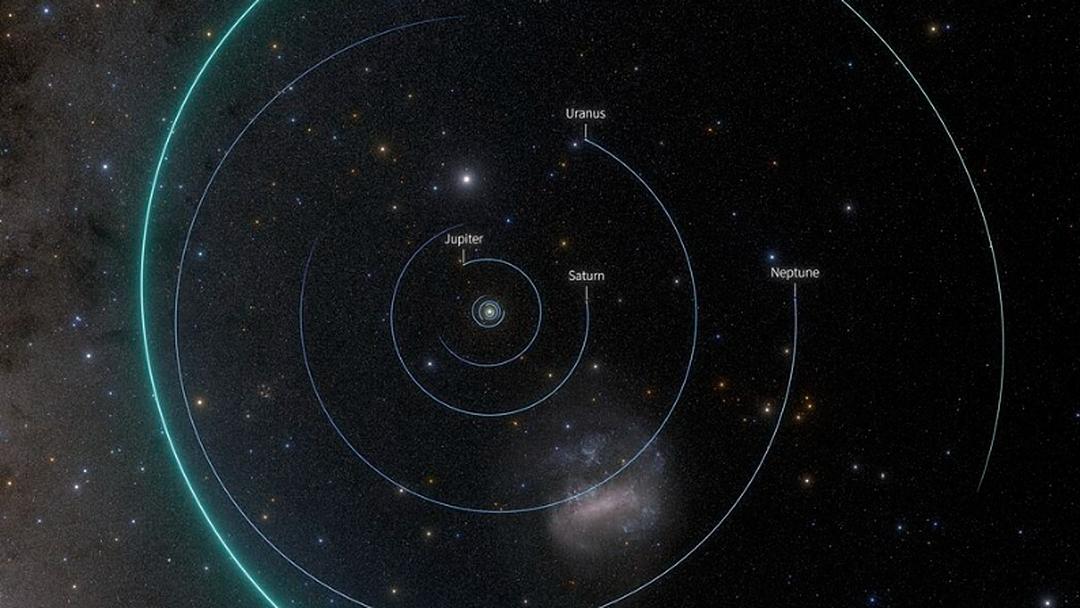
Above: Top-down view of the Solar System illustrating the orbit of the newly discovered dwarf-planet candidate ED138. Image credit: NSF–DOE Vera C. Rubin Observatory/NOIRLab/SLAC/AURA/R/via Wikimedia Commons
The Facts
- Astronomers at the Vera C. Rubin Observatory in Chile announced Tuesday that they had identified 2026 ED138, an icy object about 4.3 billion miles from the Sun that could join the five dwarf planets recognized by the International Astronomical Union.
- Researchers estimate 2026 ED138 measures between 600 and 1,500 kilometers (370 to 930 miles) across and sits about 46 times farther from the Sun than Earth, compared with Pluto's average of about 40 times that distance.
- Matthew Holman of the Center for Astrophysics, Harvard & Smithsonian, spotted the object on Oct. 13 using a search code he developed with colleague Kevin Napier. Follow-up checks found 30 Rubin detections on 20 nights between March 4 and July 11.


Sources Split
LEFT
CENTER
RIGHT
+3


+2
+1
+3
ESTAB
CRIT
CENTER
PRO
ESTAB
The Spin
Narrative A
ED138 is a compelling dwarf planet candidate. Rubin's ability to uncover overlooked worlds makes the find a landmark for outer solar system science. A richer planetary census now looks inevitable.
Narrative B
Celebrating ED138 as a dwarf planet risks turning a promising candidate into a settled classification. The bigger prize remains unresolved: distant orbital patterns may signal a hidden Mercury-to-Earth-mass world. ED138 sharpens the map but hardly settles the outer solar system's deepest mystery.


© 2026 Improve the News Foundation. All rights reserved.Version 7.18.3
© 2026 Improve the News Foundation.
All rights reserved.
Version 7.18.3