Japan Launches MMX Mission to Grab Samples From Mars Moon
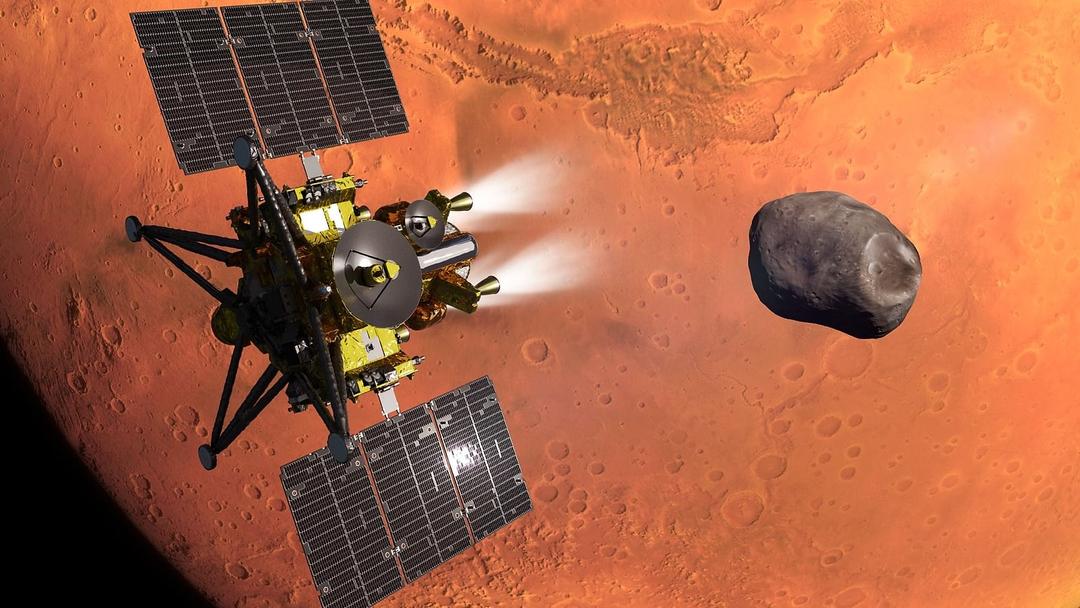
The Facts
- The Martian Moons eXploration (MMX) spacecraft is set to lift off Monday at 3:41 p.m. EDT aboard an H3 rocket from Japan's Tanegashima Space Center, corresponding to 4:41 a.m. Tuesday local time, the Japan Aerospace Exploration Agency (JAXA) said.
- The probe is expected to reach Mars in August 2027 and spend roughly three years studying Phobos, collecting at least 10 grams of surface material through two soft landings before a capsule returns the sample to Earth in 2031.
- Two leading hypotheses hold that Phobos and Deimos formed from debris left by a large object striking Mars, or that they are asteroids pulled in by the planet's gravity. Their near-circular, equatorial orbits complicate the capture scenario.


Sources Split
LEFT
CENTER
RIGHT
+1
+3
+2
+1
+3

ESTAB
CRIT
CENTER
PRO
ESTAB
The Spin
Pro-establishment narrative
Chasing the Mars system's origin justifies a five-year gamble, because a few grams of the right dust can settle debates that telescopes never will. Samples that may carry traces of Mars itself could unlock clues about water, organics and ancient habitability. With NASA's instruments aboard, this mission also shows how the U.S.-Japan alliance pays dividends far beyond Earth.


Establishment-critical narrative
Phobos has barely any gravity, making a safe touchdown and sample collection a formidable engineering challenge. The IDEFIX rover must land and right itself autonomously, while MMX has just 2.5 hours on the surface to collect samples before departing. And with the H3 rocket recovering from two failures, getting even 10 grams home by 2031 is far from guaranteed.


Pro-China narrative
While Japan targets Phobos, China is positioning itself to bring Martian soil directly to Earth, with Tianwen-3 aiming to return 500 grams by 2031. Washington has abandoned its own sample-return program, leaving China building the specialized lab needed to receive and safely analyze Martian material. If both projects stay on schedule, Beijing could control the first major opportunity to study Mars samples on Earth.